
July 22, 2026
Paragon Digicom: Trusted Telecom Service Provider in Dubai | Leading Telecom Company in UAE...
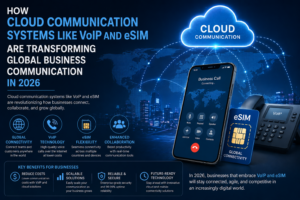
In 2026, businesses are rapidly shifting toward smarter and more flexible communication technologies. Traditional phone systems and outdated communication methods are no longer enough for global operations. Modern companies now rely on cloud communications to improve collaboration, reduce operational costs, and stay connected with customers and teams worldwide.
Technologies like VoIP and esim technology are changing the way businesses communicate across borders. Whether it is remote work, international customer support, or global business expansion, cloud-based systems are making communication faster, smarter, and more affordable.
Cloud communications refer to internet-based communication systems that allow businesses to manage voice calls, messaging, video conferencing, and collaboration tools through cloud platforms instead of traditional hardware.
Unlike old phone systems that require expensive infrastructure, cloud-based solutions operate online and offer flexibility for businesses of all sizes. Companies can communicate from anywhere using laptops, smartphones, or tablets.
The rise of communication as a service in cloud computing has made these systems even more accessible. Businesses now subscribe to communication services on demand without investing heavily in physical equipment.
Modern businesses need communication systems that support remote work, global expansion, and real-time collaboration. This is why cloud communications have become essential.
Here are some major reasons companies are adopting cloud-based communication systems:
Traditional telecom systems involve expensive maintenance and hardware upgrades. With cloud communications, businesses only pay for the services they use. VoIP calls are significantly cheaper, especially for international communication.
Remote and hybrid work models continue to grow in 2026. Cloud-based systems allow employees to connect from anywhere with internet access. Teams can easily collaborate through voice calls, video meetings, and instant messaging.
Businesses can scale their communication systems quickly. Whether hiring new employees or expanding internationally, cloud communications make it easy to add users and features instantly.
Modern cloud communication platforms include advanced security features such as encryption, authentication, and secure data storage to protect sensitive business information.
Voice over Internet Protocol (VoIP) is one of the biggest drivers behind the growth of cloud communications. VoIP allows businesses to make voice calls over the internet instead of traditional telephone lines.
VoIP systems provide several benefits for global businesses:
Many organizations are replacing conventional PBX systems with VoIP because it supports flexible communication and improves customer service efficiency.
With the growth of communication as a service in cloud computing, VoIP platforms are becoming smarter with AI-powered features like automated call routing, virtual assistants, and speech analytics.
Another innovation transforming cloud communications is esim technology. Unlike physical SIM cards, eSIMs are embedded directly into devices and can be programmed digitally.
This technology offers major advantages for international businesses:
Employees traveling internationally can switch mobile carriers digitally without replacing physical SIM cards.
Businesses operating across multiple countries can maintain stable mobile connectivity with local network providers.
Using esim technology, companies can avoid expensive international roaming charges and manage mobile plans more efficiently.
IT teams can remotely configure mobile devices, making it easier to manage communication systems for remote employees.
As mobile workforces continue to grow, cloud communications integrated with eSIM-enabled devices are becoming the standard for global business operations.
Customer expectations in 2026 are higher than ever. Businesses need faster response times and seamless communication channels to stay competitive.
By integrating VoIP, messaging apps, and video support into one cloud platform, businesses can communicate with customers more effectively.
Additionally, communication-as-a-service in cloud computing enables businesses to personalize customer interactions while maintaining operational efficiency.
Several industries are leveraging cloud-based systems to improve operational efficiency and communication.
Hospitals and clinics use cloud communication platforms for virtual consultations, appointment scheduling, and patient communication.
Online businesses rely on cloud communications for customer support, order tracking, and team collaboration across different regions.
Travel companies use VoIP and esim technology to maintain communication with international customers and remote staff.
Technology companies heavily depend on cloud-based communication systems to support distributed teams and global customer bases.
The future of cloud communications looks even more advanced with the integration of AI, automation, 5G, and IoT technologies.
Businesses can expect:
As digital transformation continues, companies that invest in cloud communication systems will gain a competitive advantage in global business operations.
In 2026, cloud communications are revolutionizing the way businesses connect, collaborate, and grow globally. Technologies like VoIP and esim technology are helping organizations reduce costs, improve flexibility, and support remote work environments.
The rise of communication as a service in cloud computing has made advanced communication solutions accessible to businesses of all sizes. From better customer experiences to seamless international connectivity, cloud-based systems are becoming the backbone of modern business communication.
Companies that adopt these technologies today will be better prepared for the future of digital communication and global business expansion.
Cloud communications are internet-based communication systems that allow businesses to manage calls, messaging, video conferencing, and collaboration through cloud platforms.
VoIP allows businesses to make voice calls over the internet, reducing international calling costs and improving communication flexibility.
Esim technology is a digital SIM solution embedded into devices that allows users to switch mobile carriers without physical SIM cards.
It enables businesses to access scalable communication solutions on-demand without investing in expensive hardware or infrastructure.
Paragon Digicom: Trusted Telecom Service Provider in Dubai | Leading Telecom Company in UAE...

The Future of VoIP: How Business VoIP Solutions Can Achieve Cost-Effective Global Communication In...

VoIP for Business Communication: What It Is and How It Can Transform Your Business...