
July 22, 2026
Paragon Digicom: Trusted Telecom Service Provider in Dubai | Leading Telecom Company in UAE...
The telecommunications industry is evolving faster than ever before. As we enter 2025, businesses and consumers alike are witnessing rapid innovations that are shaping the way we connect, communicate, and collaborate. From 5G expansions to AI-driven operations, this blog explores the most impactful telecom trends and how they will influence the future of the telecom industry globally.
Telecom trends refer to the emerging technologies, strategies, and customer demands that shape the telecom industry. These trends are important because they determine how telecom providers upgrade their infrastructure, serve customers, and stay competitive. As the digital world grows more interconnected, future trends in the telecom industry are driving transformation not just in communication but also in sectors like healthcare, education, retail, and manufacturing.
The extensive rollout and use of 5G networks is one of the most talked-about telecom prospects for 2025. Telecom operators are now shifting focus toward enhancing 5G infrastructure, improving bandwidth, and reducing latency. In some regions, discussions around 6G are already beginning, showcasing how the future trends in the telecom industry are pushing the boundaries of connectivity.
The power of 5G enables smart cities, IoT advancements, real-time gaming, and seamless virtual experiences. For telecom providers, this also means adopting more agile and scalable infrastructure, paving the way for telecom digital trends that demand high-speed, low-latency communication.
Among the most transformative telecom trends is the integration of AI and automation into telecom operations. From network management to customer support, AI is enhancing efficiency, predicting maintenance issues, and delivering personalized experiences. Telecom companies are using AI chatbots for customer interaction, machine learning for fraud detection, and predictive analytics for network performance optimization.
A significant shift is happening in how telecom infrastructure is being built. Cloud-native architecture is emerging as a key telecom trend, offering greater flexibility and cost efficiency. By moving away from legacy systems and embracing cloud solutions, telecom companies are better equipped to scale, innovate, and deliver new services.
As more data is generated at the edge of networks, telecom trends in 2025 include the increased adoption of edge computing. This lowers latency and boosts performance by enabling data processing to take place closer to the end user. For telecom, this means better support for time-sensitive applications like autonomous vehicles, remote surgeries, and AR/VR experiences.
Read Also : Transformational Resolution In Telecom Industry
With the growing complexity of digital networks, telecom trends now place heavy emphasis on cybersecurity. Protecting user data, ensuring network integrity, and preventing attacks have become top priorities for telecom providers worldwide. As services become more cloud-based and interconnected, the potential vulnerabilities also increase.
The Internet of Things, or IoT, is still expanding quickly. Connected devices—from smart homes to industrial machinery are expected to surpass 75 billion globally by 2025. This surge is fueling new telecom trends, where networks must accommodate the high data volumes and varied connection requirements of IoT devices.
Read Also : GLOBAL TELCO’S & 5G
Customer expectations are higher than ever, and telecom providers are leveraging data analytics to create personalized service experiences. One of the leading telecom trends is hyper-personalization—offering customized plans, real-time billing alerts, and AI-driven recommendations.
As environmental awareness grows, telecom trends are shifting toward sustainable operations. Telecom companies are investing in energy-efficient networks, renewable power sources, and eco-friendly infrastructure. From reducing data center emissions to using recyclable materials in hardware, the goal is to reduce the industry’s carbon footprint.
In 2025, the telecom sector is undergoing a sea change. With the rise of 5G, AI, edge computing, and cloud-native networks, the future looks more connected, intelligent, and personalized. As we navigate these telecom trends, it’s clear that innovation will continue to reshape the landscape for years to come.
Some of the top telecom trends include 5G expansion, AI and automation, edge computing, cloud-native networks, and enhanced cybersecurity.
AI improves efficiency, customer service, and network management—making it a key part of telecom technology trends.
Edge computing reduces latency and improves real-time processing, which supports advanced applications like IoT, AR, and remote operations.
Sustainability is one of the emerging telecom trends, with providers aiming to reduce carbon emissions and adopt eco-friendly infrastructure.
By leveraging telecom digital trends, businesses can offer better customer experiences, operate more efficiently, and stay competitive in an evolving market.
Paragon Digicom: Trusted Telecom Service Provider in Dubai | Leading Telecom Company in UAE...

The Future of VoIP: How Business VoIP Solutions Can Achieve Cost-Effective Global Communication In...
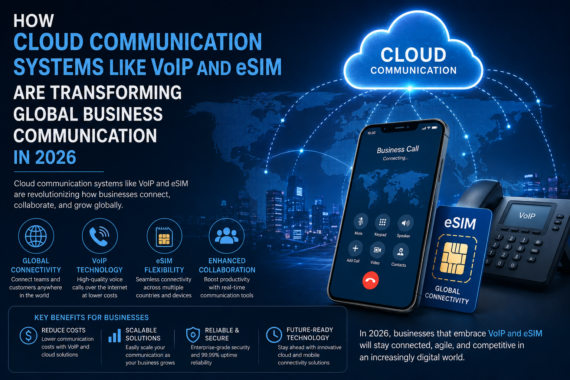
How Cloud Communications Systems Like VoIP and eSIM Are Transforming Global Business Communication in...