July 22, 2026
Paragon Digicom: Trusted Telecom Service Provider in Dubai | Leading Telecom Company in UAE...

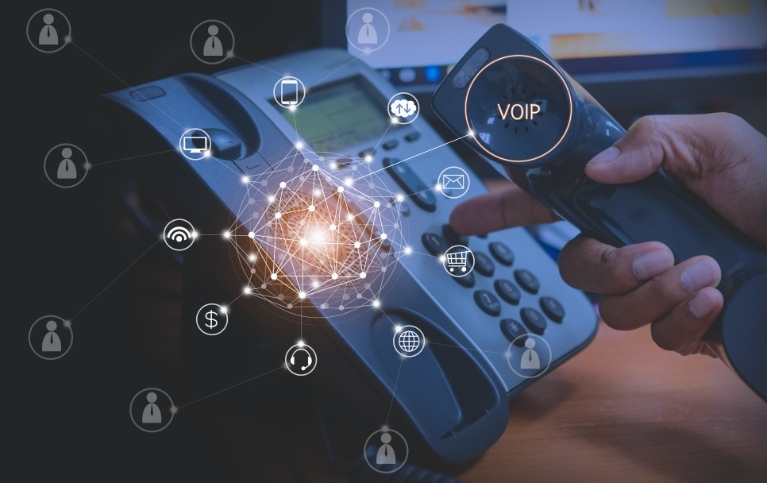
Voice over Internet Protocol (VoIP), is an innovation that permits you to set up voice calls by employing broadband Internet connection rather than an analog telephone line. Some VoIP service providers may just permit you to call others utilizing a similar assistance, yet others might permit you to call any individual who has a phone number – including nearby, distant, mobile, and worldwide numbers. Additionally, while some VoIP benefits just work over your PC or a unique VoIP telephone, different service providers permit you to utilize a conventional telephone associated with a VoIP adaptor.
Whenever a long distance call is made, chances are higher that it’s a VOIP call. By directing a large number of calls through the circuit switched network into the IP gateway the bandwidth is usually compressed than the original bandwidth used for the long distance communication. However, on the other hand the call is de-compressed, reassembled and is directed to the local circuit-switched networks.
The advanced features offered by the VOIP companies for which they don’t even extra-charge their clients are: Caller Id, call waiting, call transfer, redial, return call, three-way calling.
Let’s have a look on how VOIP really works and how it improves the conventional calling system.
Circuit-Switched Networks:
Circuit-switching has been used over 100 years by the traditional telephone systems. It is a reliable but in-efficient way of making phone calls also termed as Public Switched Telephone Networks (PSTN). When you make a phone call, a connection is made between two end-points known as circuit. This method of calling is quite expensive as each connection requires dedicated copper wires, and it increases with the distance increased.
Read Alos: Future of Communication (SIP and VoIP)
Telephone calls are more efficient today as the voice is digitized and is sent over the fiber optics over the total transmission rate of 128 kbps. Briefly, if you look closely to a phone conversation much of the data transmitted is wasted.
Packet-Switched:
In packet-switched networks, one person talks at a time. Thus, efficiency is improved and the bandwidth is cut down to 4.7 Mbs. Moreover, the silence (none of them is talking) consumes most of the part of the conversation which is dead air. Hence, only noisy packets are sent instead of silent packets which improves efficiency significantly.
Packet switching is a short link just to send small bundle of data from one party to another. Packet-switching is extremely proficient which allows the packets to route over least expensive and uncongested lines. It also frees up the two computers communicating with each other so that they can accept information from other computers, as well.
Author: Ayesha Urooj
Paragon Digicom: Trusted Telecom Service Provider in Dubai | Leading Telecom Company in UAE...

The Future of VoIP: How Business VoIP Solutions Can Achieve Cost-Effective Global Communication In...
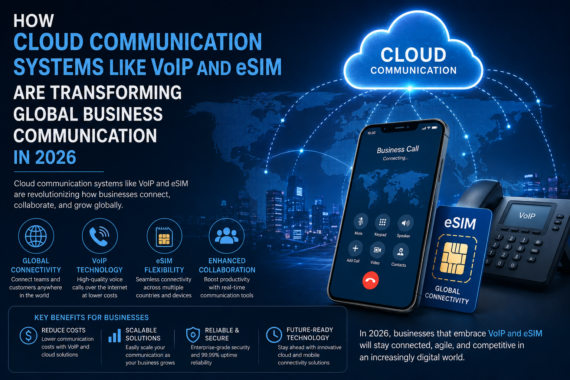
How Cloud Communications Systems Like VoIP and eSIM Are Transforming Global Business Communication in...